Small messages, long battery life
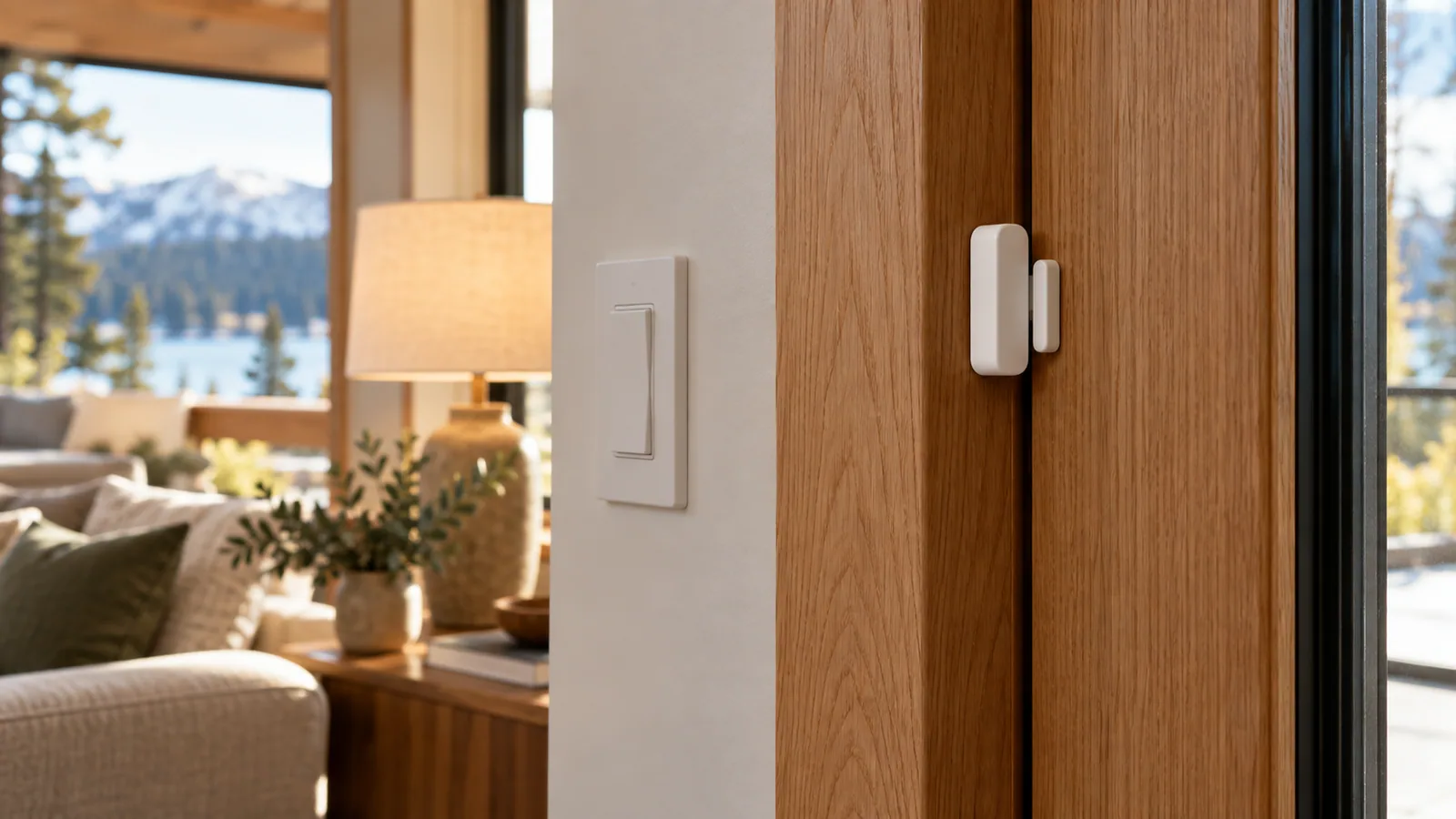
A door sensor does not need to send a video. It may only report open, closed and battery status. Zigbee and Z Wave were built around this kind of small, infrequent message. They commonly use a compatible hub or controller to connect the device network to apps and automations. A hub is not just a convenience; without the right one, the device may not be usable.
A powered light, plug or switch can often relay messages through a mesh. A sleeping battery sensor usually does not relay for others, because doing so would drain its battery. That distinction matters when choosing where to place devices.
Zigbee: flexible and widely used
Many home Zigbee products use the 2.4 GHz band, which also carries Wi Fi and Bluetooth. Zigbee can create a mesh of powered devices and support battery sensors. The Connectivity Standards Alliance cites transmission distances of roughly 10 to 100 metres depending on radio power and the environment. That is a broad technical span, not a promise across a particular house.
A Zigbee product may be easy to find and economical, but compatibility still requires care. Check that the exact device works with the chosen coordinator, software platform and feature set. A device joining a Zigbee network does not guarantee every advanced function will appear in the app.
Z Wave: a different band and a certified ecosystem
Z Wave usually uses a sub 1 GHz band, outside the busy 2.4 GHz Wi Fi band. The exact frequency varies by region. Traditional Z Wave forms a mesh with compatible powered repeaters; its controller manages the network. Product manuals often describe open air reach around 30 to 40 metres for a single hop, but walls, metal boxes and device placement can shorten that substantially.
Do not buy an overseas Z Wave device based only on its plug shape. Regional radio versions may differ and may not be compatible or permitted where the device will be used. Confirm Canadian market support and the exact controller model.
What Z Wave Long Range changes
Z Wave Long Range is a mode designed for direct communication between compatible devices and a compatible hub rather than hopping across the traditional mesh. The Z Wave Alliance describes a very large maximum range under favourable conditions. Treat that as a technical ceiling, not a normal house result. A garage, outbuilding or difficult edge location still needs an on site test.
Long Range is not the same as simply having a newer Z Wave device. Both the controller and the endpoint must support the mode, and the region and product details matter.
How to choose between them
Begin with the devices and controller you actually want. A well supported Zigbee network can be more useful than a theoretically longer range Z Wave device that your controller cannot handle, and the reverse is also true. Note how many powered devices can create a healthy mesh before putting battery sensors at the edge.
Check local control, inclusion and removal procedures, firmware support, replacement availability and how the system behaves when its hub loses power. Keep a simple record of device models and locations so future repairs do not become guesswork.
CHECK THE SOURCE
Official reading
Standards and products evolve. These links lead to the organizations that publish or administer the technologies discussed above.
Wireless distances are estimates, not a guarantee for a particular home. Verify the exact product, regional version, controller support and final installation location. Reviewed 12 October 2026.